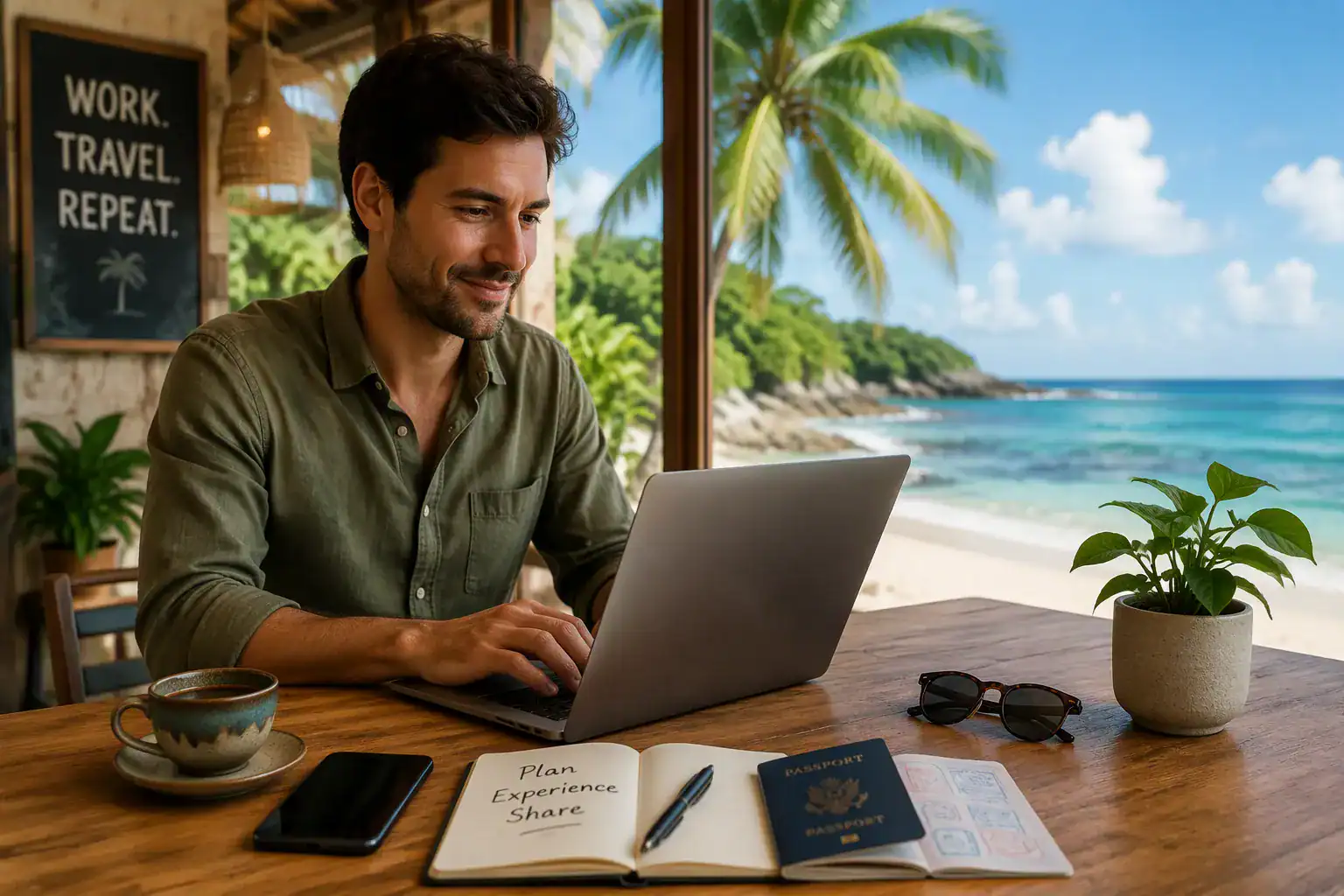


Picture this: you wake up in a charming new city, coffee in hand, laptop ready. Then reality hits—your savings are shrinking, and panic sets in. The digital nomad lifestyle looks glamorous on Instagram, but the real challenge is sustainability. You’re not alone in wondering, “How can I afford this without draining my bank account?”
Here’s the truth: nearly 45% of digital nomads live month-to-month with no safety net. Yet over 43 million people worldwide have figured out how to make it work. The difference? Smart money management.
This guide gives you a practical roadmap covering budgeting, income streams, banking, taxes, and travel hacks—all tailored for 2026. Financial planning isn’t restrictive; it’s your key to genuine freedom. By the end, you’ll have a clear action plan to make your nomadic dreams financially viable.
Key Takeaways
Make a budget that includes 25% extra money for surprise costs.
Make money in more than one way by freelancing and earning from passive income.
Use multi-currency accounts like Wise or Revolut to cut down on fees.
Know your tax home and set aside 25-30% for taxes.
Save up enough money to cover your costs for 3 to 6 months in case of an emergency.
Digital Nomad Budgeting Basics
Before you book that flight or rent that beachfront bungalow, you need a clear picture of your finances. Smart budgeting isn’t about restricting yourself—it’s about making your travel dreams last longer than one paycheck. Let’s break down how to build a budget that actually works on the road.
Calculate Your Monthly Budget
Start with a framework that fits your income style. The 50/30/20 rule works well for steady earners, but you might prefer zero-based budgeting if your income fluctuates. Here’s how these approaches compare:
Framework | Core Principle | Example for Digital Nomad |
|---|---|---|
50/30/20 Budget | Divide income into three buckets: 50% essentials, 30% discretionary, 20% savings. | Allocate $2,250 to rent/food/insurance, $1,350 to travel/entertainment, and $900 to savings from a $4,500 monthly income. |
Zero-Based Budget | Allocate every dollar of income to a specific expense category until cash flow equals zero. | A nomad earning $4,500/month assigns $1,700 to accommodation, $400 to food, $300 to transport, $200 to flights, and $900 to a high-yield savings account, among other line items. |
Pay-Yourself-First Budget | Prioritize savings by setting aside money for savings before tackling expenses and discretionary spending. | Automatically transfer a fixed amount (e.g., $1,000) to savings at the start of each month, then use the remaining $3,500 for living costs and leisure. |
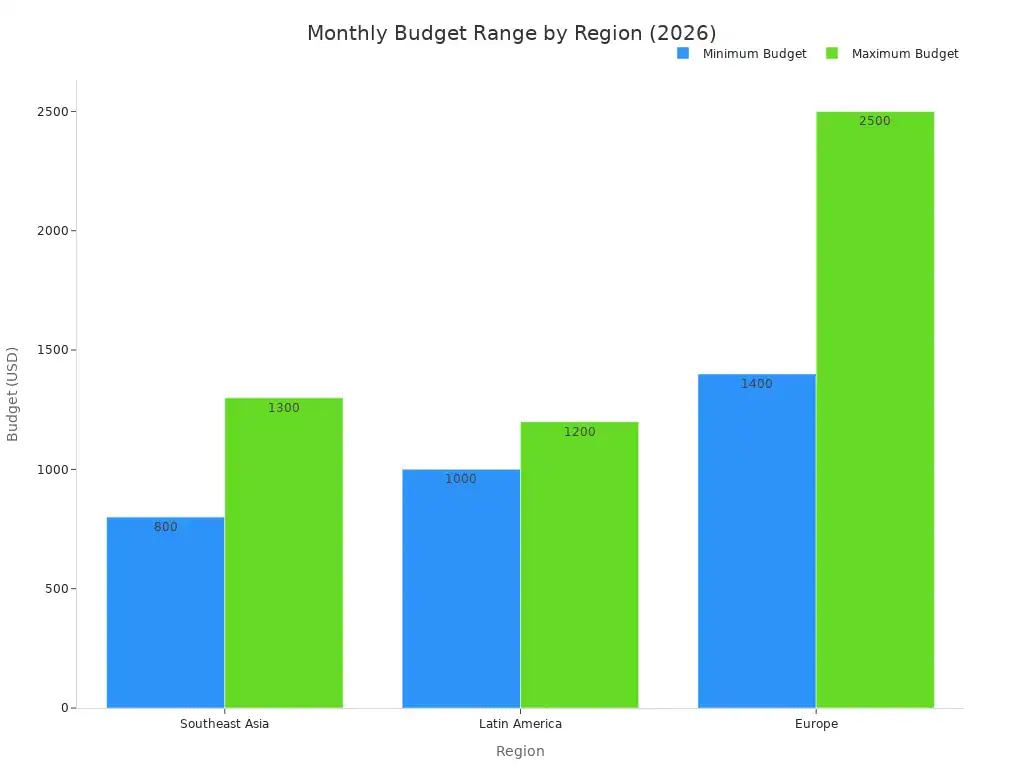
Your target monthly budget depends heavily on where you roam. In 2026, Southeast Asia remains the most affordable region, with monthly costs ranging from $800 to $1,300. Latin America sits comfortably in the middle at $1,000 to $1,200, while Europe demands the most at $1,400 to $2,500.
Here’s a golden rule: add a buffer of 25% to your estimated monthly expenses. Travel costs fluctuate, currency exchange rates shift, and hidden fees appear when you least expect them. That cushion keeps your budget realistic and your stress levels low.
Use the 3-Tier Budget Framework – Choose a tier that matches your income stability and travel intensity.
Track Expenses with Modern Tools
Once you’ve set your budget, you need to track your money consistently. Manual tracking fails quickly, so use apps designed for life on the move. Here are the top options for 2026:
App | Best For | Key Feature |
|---|---|---|
Business owners | SmartScan AI for automatic receipt scanning and reimbursement | |
Zoho Expense | SMEs and teams | Global compliance rules for multi-country tax handling |
Revolut Business | All-in-one banking | Real-time foreign exchange and card controls |
PocketSmith | Forecasting | Calendar-based budgeting to predict future spending |
FreshBooks | Freelance service providers | Seamless integration of receipt capture with client invoicing |
These tools do more than track your expenses—they help you spend intentionally. Look for apps with multi-currency support, offline mode, and OCR receipt scanning that works in foreign languages. A solid app turns daily spending into clear data you can review weekly.
Good money management also means watching your biggest costs closely. Housing and flights eat up most of your budget, so prioritize those categories. Use credit card points for long-haul flights, choose shared living spaces in expensive cities, and cook at home where groceries cost less than eating out.
Remember, budgeting tips only work when you apply them consistently. Set aside fifteen minutes each Sunday to review your spending, adjust your categories, and plan the week ahead. That small habit keeps your finances healthy and your travels sustainable.
Build a Flexible Spending Plan
Your budget needs to change, not break, when you move between countries. A strict plan works well if you stay in one place, but nomads face different costs everywhere. You must adjust your spending to fit each new place.
Adapt Your Budget to Travel Costs
Southeast Asia gives you great value, with monthly living costs from $800 to $1,300. Western Europe costs much more, often $1,400 to $2,500 each month. You cannot use one number for every spot. Instead, research your destination before you arrive. Check local prices for food, transport, and coworking spaces online. Set a daily spending goal based on real facts, not guesses.
Your budgeting method should change too. In pricey cities, eat out less and pick shared housing. In cheap areas, you can spend on fun without worry. This flexibility keeps your total travel costs balanced all year. Track your daily spending against your goal each evening. Fix quickly when you spend too much. Small fixes today stop big money stress tomorrow.
Save on Accommodation and Flights
Housing and flights are your biggest costs, so focus your money-saving efforts there. House-sitting offers a big change. Platforms like TrustedHousesitters connect you with homeowners who need care while away. You stay free in return for looking after their home and pets. This method works great in expensive cities or during busy seasons.
Expense Category | |
|---|---|
Platform subscriptions (2-3) | $200-500 USD |
$400-800 USD | |
Transport between assignments | $2,000-5,000 USD |
Food and daily living | $6,000-10,000 USD |
Communication (eSIM, VPN) | $200-400 USD |
Miscellaneous (visas, vaccines, gear) | $500-1,000 USD |
Annual Total | $9,300-17,700 USD |
Compare that to $30,000-50,000 USD for normal hotel travel. Full-time house sitters save $15,000-25,000 USD each year just on housing. That’s real money you can use for fun or savings.
For flights, being flexible saves you hundreds. Use Google Flights, Skyscanner, or Momondo to set price alerts. These tools tell you when prices drop on routes you want. Travel mid-week or during slow seasons to cut costs more. Services like Scott’s Cheap Flights warn you about mistake fares and big drops. These cost-saving tips need little work but give big rewards. Your money goes further when you plan smart, not when you hold back.
Diversify Income for Digital Nomads

Relying on one client or job is risky. You need multiple streams of income to stay afloat. The most successful digital nomads build a portfolio of earnings that keeps money flowing even when one source dries up.
Create Multiple Revenue Streams
Freelancing remains a solid foundation. According to a 2024 Payoneer survey, over 65% of freelancers reported higher earnings year-over-year. The global demand for remote services keeps growing. You can tap into this market with skills like writing, coding, or design.
Income Stream | |
|---|---|
Freelance Writing | $50-200+ |
Web Development & Programming | $80-150+ |
Digital Marketing | $75-200 |
Graphic Design | $40-100+ |
Virtual Assistant Services | $25-50+ |
Consulting & Coaching | $150-500+ |
These rates show real earning potential. But don’t stop at client work. Passive income adds stability to your money management strategy. Consider these options:
Affiliate Marketing: Build a website around a niche and earn commissions on product sales through links.
Digital Products: Create templates, Notion dashboards, or printables that generate income long after creation.
Online Courses & Workshops: Package your expertise into a course on platforms like Teachable or Podia.
YouTube or Podcasting: Build an audience and earn through sponsorships and ads.
Etsy Print-on-Demand: Upload designs and let the platform handle orders and shipping.
You can also find remote jobs on boards like RemoteOk.io. For building skills, platforms like Udemy, Skillshare, and Codecademy offer affordable courses. BreakOutwards’ Nomad Academy provides targeted training for remote income skills, with courses starting at $5.99. These resources help you learn without breaking the bank.
The most successful digital nomads typically combine multiple income streams. Start with high-value client services, develop digital products, then build passive income streams.
Focus on mastering one stream before adding another. Avoid shiny object syndrome. One year, one goal. This approach keeps your income growth steady and manageable.
Manage Irregular Income Effectively
Freelance income fluctuates. Some months bring plenty, others feel tight. You need a system to handle this variability. Start by setting aside 25-30% of each payment for taxes. This prevents a huge bill at tax season.
Make estimated tax payments every three months using accounting software like QuickBooks or FreshBooks. This keeps you compliant and avoids penalties. Calculate your average monthly income over 6-12 months. Base your essential spending on your lowest-income month, not your best one.
Build an emergency fund covering 3-6 months of living expenses. Start small with contributions like $50 per month. In high-income months, save at least 20% of earnings as a buffer for lean periods. This extra savings protects you when work slows down.
Open a Traditional or Roth IRA and contribute regularly, such as $500 per month. This grows your retirement savings over time. Use budgeting apps like YNAB, Mint, or EveryDollar to monitor cash flow and adjust spending. These tools show you exactly where your money goes each week.
Your money management plan should also account for irregular expenses. Travel costs and visa fees appear without warning. Keep a separate category for these surprises. Review your budget weekly and adjust your spending goals based on recent earnings.
The key is consistency. Track every payment, set aside savings first, and spend from what remains. This discipline turns irregular income into a stable foundation for your travels. You gain peace of mind knowing your finances can handle the ups and downs of nomadic life.
Banking Solutions for Digital Nomads
Standard banks charge hidden fees that quickly use up your travel money. The right banking setup can save you hundreds of dollars each year. You need accounts made for moving around, not for staying in one spot.
Choose a Multi-Currency Account
A multi-currency account lets you keep, send, and use money in different currencies without paying high conversion fees. Wise is a great choice for freelancers who send bills in many currencies. It holds more than 50 currencies and gives you local bank details in more than 10 currencies. Conversion fees begin at 0.41%, and there is no monthly fee. You get the real exchange rate with clear pricing.
Account | Monthly Cost | Key Feature |
|---|---|---|
Wise | $0 | Holds 50+ currencies; local details in 10+ currencies; conversion from 0.41% |
Revolut Standard | $0 | Fee-free spending up to $1,000/month; ATM free limit $200/month |
Revolut Premium | $9.99 | Unlimited fee-free exchange; ATM free limit $400/month; travel insurance |
N26 Standard | $0 | No foreign transaction fees; free ATM withdrawals in euros |
The best way is to use several accounts together. Keep a bank account in your home country for stability and credit history. Use Wise as your main account to get paid by clients. Use Revolut as your card for everyday spending. This setup lowers foreign transaction fees from 2.75-3% down to almost nothing. If you spend $2,000 each month, you save $660 to $720 per year.
Minimize Fees on Withdrawals
ATMs in other countries charge many fees at the same time. You pay the ATM company’s fee, your bank’s fee for using a foreign ATM, and hidden exchange rate markups. These costs add up quickly if you take out small amounts often. Smart methods can cut these costs to nearly zero.
Always pick the local currency when an ATM asks you. This says no to Dynamic Currency Conversion, which adds a hidden fee. Take out larger amounts less often so the fixed fee is spread over more cash. Use ATMs that belong to a bank instead of Euronet or machines in tourist spots. These easy habits save you real money over time.
For US residents, Charles Schwab gives back all ATM fees worldwide and charges no foreign transaction fees. This removes both the ATM company’s fee and your bank’s fee completely. Non-US nomads can use Wise or Revolut to get free withdrawals up to their monthly limits. Carry a backup card in case your main card gets blocked or lost. Check your transactions every week to spot any problems early.
Simple habits make your money work for you instead of going to fees. Set up accounts before you leave, test them with small amounts, and always say no to conversion offers at ATMs. This system protects your budget and lets you focus on your travels.
Navigate Taxes and Legalities
Taxes might not be the fun part of traveling, but doing them right protects your money. Many travelers ignore this until they get into trouble. You can avoid that stress with some early knowledge.
Understand Your Tax Residency
Your tax residency tells which country can tax your income. Most countries start with the 183-day rule. If you stay more than 183 days in one place, you usually become a tax resident there. But there are exceptions everywhere.
Country | 183-Day Rule Application | Key Exception |
|---|---|---|
Germany | May tax you even under 183 days | Habitual abode or permanent home available |
UK | Uses Statutory Residence Test with day count and ‘ties’ | Can become resident with fewer than 183 days based on connection score |
Portugal | Applies the 183-day rule | Non-Habitual Residency program allows little/no tax on foreign income for 10 years |
US | Uses Substantial Presence Test with weighted 3-year formula | Closer connection exception available if under 183 days in current year |
The US test is tricky. The formula is: current year days plus one-third of last year’s days plus one-sixth of the year before that. If the total is 183 or more, and you were in the US at least 31 days this year, you become a US tax resident. The closer connection exception helps if you spent under 183 days in the US, kept a tax home abroad, and filed Form 8840.
Different situations lead to different results. A remote worker in Portugal might avoid tax residency by moving often and pay no US tax with the Foreign Earned Income Exclusion. A self-employed consultant in Thailand could lower self-employment tax with an S corp. A crypto trader in the UAE tells the IRS about gains but pays no UAE tax. An online business owner in Mexico becomes a Mexican tax resident and uses the Foreign Tax Credit to cancel US tax.
Stay Compliant with Simple Strategies
You don’t need to be a tax expert. You just need the right help and tools. There are services made for digital nomads.
Greenback Expat Tax Services has flat-fee packages. Annual Expat Tax Filing with FEIE is $565. Freelance and Self-Employment Filing is $565. Small Business and Entity Filing is $750. Catch-Up Filing via Streamlined Procedures is $1,750. Strategic Tax Consultation starts at $250. State Tax Returns cost $185. These services handle FEIE, FBAR, and self-employment tax.
NSKT Global gives special help to digital nomads. They help you figure out residency, make the most of the Foreign Earned Income Exclusion and Foreign Tax Credit, and stay compliant with US tax rules.
Cloud-based accounting software like QuickBooks, Xero, or FreshBooks makes record-keeping easier. You can track income and expenses from anywhere, so tax season is not a hassle.
Good money management means saving 25-30% of each payment for taxes. Make estimated quarterly payments to avoid fines. This habit keeps your money steady and your travels worry-free.
Long-Term Financial Planning
Retirement might seem far away when you’re exploring new countries, but nomads who do well in their 60s began planning in their 20s. Your future self will be glad you made smart choices today. Thinking long-term keeps your travels going and your freedom safe.
Invest for Retirement as a Nomad
You have good options for retirement savings that work across borders. Traditional and Roth IRAs give tax benefits, and a Solo 401(k) works well if you’re self-employed. But here’s the issue: these accounts connect to your home country. Moving abroad can cause surprise tax problems. US citizens risk paying taxes twice on Roth IRAs when they leave. Some countries may even try to take back tax benefits you already got.
Strategy Category | Key Recommendations |
|---|---|
Flexible Global Investments | Use global brokerage accounts like Interactive Brokers or Charles Schwab for borderless access |
Retirement Accounts | Utilize IRAs (Traditional/Roth) and Solo 401(k) for tax-advantaged savings |
Tax Management | Leverage Foreign Earned Income Exclusion (FEIE) and geographic arbitrage to reduce taxes |
Sustainable Withdrawal | Adapt the 4% rule and use bucket strategy for flexible retirement withdrawals |
The smart method focuses on plans that save you money on taxes now rather than ones that promise tax-free withdrawals later. Moving between countries brings uncertainty, so you want benefits you can rely on today. Always talk to a qualified tax advisor before moving with large retirement savings. They can help you avoid costly mistakes that reduce your savings.
Build an Emergency Fund
Your emergency fund is your safety net. Without it, one bad month could end your travel life. Try to save 3-6 months of living costs in a high-yield savings account. This money stays separate from your daily spending, ready for when life throws surprises.
Start small if you must. Put aside $50 from each paycheck. Raise that amount during months when you earn more. The goal is steady effort, not perfection. Your emergency fund protects you from surprise costs like medical issues, canceled flights, or sudden equipment breakdowns. It also gives you peace of mind when client work slows down and income becomes uneven.
Base your emergency fund goal on your lowest monthly income, not your best month. Include housing, food, travel, insurance, and debt payments in your math. This realistic number makes sure your fund actually covers you when times get hard. Keep this money in a separate account so you don’t spend it by accident. Your future self will be glad when the unexpected happens.
Cut Travel Costs Without Sacrifice
You can keep your budget healthy without giving up comfort. Smart choices about where you go and how you book can make your money last longer. You won’t feel like you’re missing out. The trick is picking affordable places and staying longer in each one.
Choose Affordable Destinations
Where you go makes the biggest difference in what you spend each month. Vietnam is still a top choice for digital nomads. You can live well there on $800 to $1,000 per month. Mexico gives you similar value, especially in cities like Oaxaca or Mérida. Rent, food, and transport stay very low there. Portugal’s smaller towns, such as Braga or Coimbra, offer European charm without the high Lisbon prices.
These budget-friendly spots don’t cut corners on quality. You still get reliable internet, lively coworking spaces, and rich local culture. The key is doing research before you arrive. Check local cost-of-living websites and talk with other travelers in online forums. This prep helps you plan your affordable travel using real numbers, not guesses.
Leverage Long-Term Stays
Booking a place for one to three months usually cuts your monthly cost by 30–50% compared to short-term rentals. That’s a big saving you can put toward experiences or savings. Airbnb’s search filters make this easy. Pick a month-long stay and the platform shows listings with 30% or more off the nightly rate.
Monthly discount filter: Use Airbnb’s filter for 30+ nights to see reduced rates right away.
Direct negotiation: Reach out to hosts and ask for a custom offer. You can often get prices up to 50% below the normal listed price, especially for longer stays.
Community retreats: Join groups like BreakOutwards for retreat-based stays that bundle accommodation, coworking, and community at a fraction of what you’d pay separately.
These strategies help you lower travel costs while keeping your experience full. You trade a little flexibility for big savings. That means more money for exploring, eating well, and enjoying your new surroundings. The numbers work in your favor when you commit to staying put for a while. Your wallet thanks you, and you get to know a place better than a quick tourist visit.
Protect Your Finances and Health
Get Essential Travel Insurance
Regular travel insurance does not work for digital nomads. Most plans limit trip length and do not cover routine care. Domestic health plans often stop covering you once you leave your home country. You need international health insurance made for long stays in many countries. These plans give you access to good healthcare wherever you go.
Look for plans that include medical coverage, trip cancellation protection, and emergency evacuation services. These features protect your money and shield you from surprise costs that could ruin your travels. Even a minor illness or travel delay can lead to big bills without proper coverage. Many digital nomad visa programs also require proof of health insurance to enter. Emergency evacuation coverage can save you thousands if you need transport from a remote area.
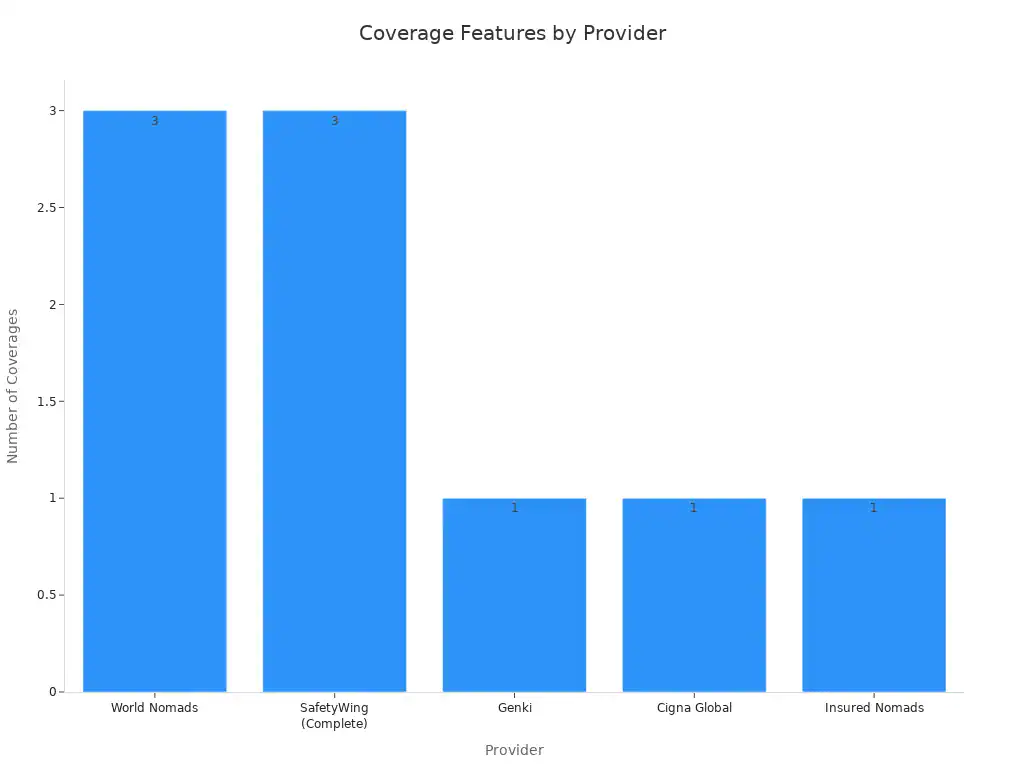
Here’s how the top providers compare:
Provider | Health Coverage | Gear Coverage | Trip Cancellation |
|---|---|---|---|
World Nomads | Yes (medical emergencies) | Yes (tech gear) | Yes (Explorer plan) |
SafetyWing (Complete) | Yes (full health insurance) | Yes (add-on for electronics) | Yes (travel protections) |
Genki | Yes (emergency, dental, mental health) | No | No |
Cigna Global | Yes (comprehensive medical) | Not specified | Not specified |
Insured Nomads | Yes (medical, telehealth) | Not specified | Not specified |
SafetyWing and World Nomads give the most complete packages. They cover both health and gear protection. Pick a provider that fits your travel style and destination needs.
Safeguard Your Digital Assets
Your money safety depends on strong digital habits. Start with a VPN that uses strong encryption and follows a no-logs policy. Stay away from free VPNs because they often hurt your privacy. Use a password manager like LastPass or 1Password to create and store complex passwords for every account. This way one stolen password does not affect your other accounts. A password manager also helps you make truly random passwords that are hard to crack.
Turn on two-factor authentication on all financial and work-related platforms. This adds extra protection even if someone steals your password. Check your bank transactions and login histories often. Catching unusual activity early limits the damage. Set aside time each week to look for anything odd in your accounts. Watch for charges you do not recognize or login attempts from new places. These simple habits keep your money safe while you travel the world.
You now have the roadmap: a realistic budget, diversified income streams, smart banking, tax awareness, and long-term planning. These pillars work together to make your digital nomad dream sustainable. Money management isn’t about restriction—it’s about unlocking freedom to explore without fear.
Start with one small step today. Calculate your baseline budget or open a multi-currency account. Build momentum from there. Each action brings you closer to confidence.
Ready to leap? BreakOutwards’ community and retreats offer structure, support, and connection with fellow travelers who understand your journey. You don’t have to figure this out alone.
The world is waiting. With the right financial foundation, you can venture onward with confidence and make 2026 your year of adventure.
FAQ
How much money do I need to start?
You can begin with $3,000 to $5,000 saved. This covers your first month in a budget-friendly country, flights, insurance, and a safety cushion. Start smaller if needed. Choose Vietnam or Mexico first. Your money stretches further there, giving you time to build income while you travel.
What if my income isn’t steady?
That’s normal for most digital nomads. Base your spending on your lowest earning month, not your best one. Set aside 25-30% of each payment for taxes. Build an emergency fund covering 3-6 months of living expenses. This buffer keeps you calm when work slows down.
Which bank account works best abroad?
Open a Wise or Revolut account before you leave. Both hold multiple currencies and charge tiny conversion fees. Keep your home bank account for stability. Use Wise to receive client payments. Use Revolut for daily spending. This setup saves you hundreds each year on foreign transaction fees.
Do I really need travel insurance?
Yes, absolutely. One medical emergency can wipe out your entire travel budget. SafetyWing and World Nomads offer plans designed for long-term travelers. They cover health care, gear damage, and trip cancellations. The cost is small compared to the protection you gain. Don’t skip this step.
What’s the first step I should take?
Calculate your baseline monthly budget using real numbers from your target destination. Add a 25% buffer for surprises. Then open a multi-currency account. These two actions take less than an hour. They give you clarity and confidence to plan your next move.