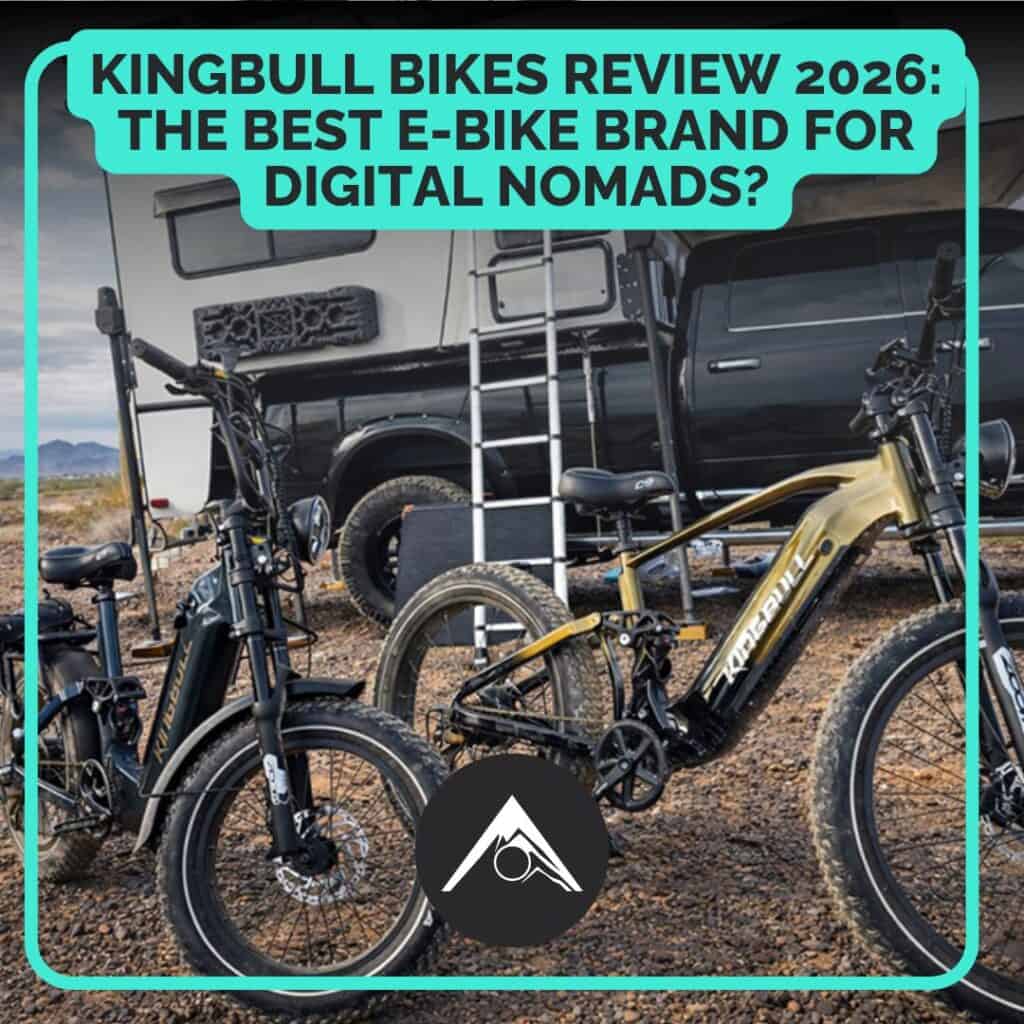
Kingbull Bikes Review 2026:
The Best E-Bike Brand for Digital Nomads?
The location-independent life runs on mobility. Whether you’re parked up at a coastal campground in Oregon, working from an Airbnb in Lisbon for the summer, or road-tripping across the Pacific Northwest with a laptop in your bag, the question of “how do I actually get around once I arrive” never really goes away. Rental cars eat into the budget. Public transit isn’t always practical. And walking has a hard limit on how much you can see in a day.
That’s where an electric bike enters the picture — and increasingly, why digital nomads, van-lifers, and road-trip travelers are paying attention to brands like Kingbull Bikes.
This isn’t a “we tested every Kingbull bike for six months” review. Break Outwards is a digital nomad publication, not an e-bike lab. What this is: an honest brand-level assessment of where Kingbull fits in the nomad lifestyle, who their bikes are built for, and where they fall short. We’ve dug through the specs, the third-party reviews, the YouTube test rides, and the owner feedback to figure out whether this brand earns a place in the conversation for our community.
The short answer: for a specific kind of traveler — one with a car, SUV, van, or RV; based in the US or shipping to a US address; looking for a long-range e-bike that won’t drain the bank account — yes, Kingbull is worth a serious look.
Here’s the full breakdown.
Who Is Kingbull?
Kingbull is a direct-to-consumer electric bike brand focused on fat-tire, long-range, and folding e-bikes. They ship from a California warehouse, offer free shipping inside the US, carry UL 2849 certification on their bikes (the safety standard that matters for e-bike electrical systems), and back their products with a two-year warranty.
The lineup spans the main categories a traveling rider might care about:
- Folding e-bikes: Verve, Literider 2.0, Trekker
- Off-road and mountain e-bikes: Hunter 2.0S, Ranger, Rover 2.0
- City and commuter e-bikes: Discover ST 2.0
- Cargo e-bikes: Voyager 2.0 (single or dual battery)
Pricing sits in the $1,200–$2,000 range, putting Kingbull in the same tier as Lectric, Heybike, Engwe, and Mokwheel — the direct-to-consumer mid-market segment that’s eaten enormous share from legacy bike brands over the last few years.
→ Browse the full Kingbull lineup
Why an E-Bike Matters for the Digital Nomad Lifestyle
The case for owning an e-bike scales with the kind of nomad you are.
If you’re flying internationally and changing locations every few weeks, an e-bike is impractical — heavy, fragile, and a logistical headache to ship or check on a plane. For that lifestyle, scooter rentals, dockless e-bike apps, and local public transit are the right answer.
But there’s a different kind of nomad: the one with a car, an SUV, a van, or an RV. The slow-traveler. The van-lifer. The remote worker doing a six-month tour of US national parks. The expat parked up in one place for a season. For these travelers, an e-bike isn’t a burden — it’s a force multiplier.
You drive to a beautiful place, park, pull the bike out, and your exploration radius expands from “as far as I can walk” to “20–40 miles before I think about turning around.” On a Class 3 e-bike with assist, that’s a different relationship with a destination entirely.
A few practical reasons it matters:
- No fuel costs for short trips. A full battery charge runs you a few cents, versus the cost of starting up the car for every coffee run.
- No parking hassle. Most beach towns, national park gateway towns, and tourist-heavy small cities have brutal parking. A bike skips the entire problem.
- Wider exploration. Trails, beach paths, narrow streets in old towns — places a car can’t follow you.
- A counterweight to sedentary work. Remote work is hard on the body. A 30-minute morning ride is a meaningful offset.
- Cheaper than rental cars for in-place exploration. If you’re somewhere for a month, you’ll often spend more on a rental than the bike cost in the first place.
The catch: you have to be able to transport the bike. Which is where Kingbull’s folding models become the most interesting part of their lineup for this audience.
What Sets Kingbull Apart from Other Direct-to-Consumer E-Bike Brands
A few things stand out when you compare Kingbull to the broader direct-to-consumer e-bike crowd.
Long range is the headline
Most of their models advertise 60–80 miles of range under ideal riding conditions. That’s a function of how much battery they’re packing on each bike — typically 960Wh on the higher-end models, which is large by mid-market standards. Real-world range will always come in lower than the marketing number (depends on rider weight, terrain, wind, assist level), but the ceiling is meaningfully higher than most competitors at this price.
For a nomad use case, range translates to “fewer recharge stops” and “more confident multi-day exploration.” That matters more than it sounds.
UL 2849 certification
This is worth pausing on. E-bike battery fires have become a real enough issue that New York City has banned non-UL-certified e-bikes from many buildings. UL 2849 is the safety standard that covers the full electrical system of an e-bike — not just the battery cells, but the controller, charger, and wiring as well. A lot of cheap direct-to-consumer e-bikes don’t carry this certification, and the risk isn’t theoretical.
Kingbull publishes their certification documents on the product pages. It’s a real trust signal and a good reason to prefer them over uncertified competitors at the same price.
US warehouse and fast shipping
Bikes ship from California within 2 business days, with delivery typically in 2–5 business days. This is a meaningful operational advantage over brands that drop-ship from overseas — you’re not waiting weeks for delivery, and warranty claims or returns are far easier to handle.
Two-year warranty
Industry standard is one year. Two years is generous in this segment. (Read the fine print on what’s covered — most warranties exclude wear items like tires, chains, and brake pads, which is standard.)
Component spec for the price
The bikes use Bafang motors, Samsung battery cells, Tektro hydraulic brakes, and Shimano drivetrains. None of these are premium-tier (you won’t find Bosch motors or SRAM drivetrains here), but they’re all reputable brands with real engineering behind them — more than you can say for some budget e-bikes that pack in unbranded components and hope you don’t notice.
The Kingbull Lineup at a Glance
Here’s how the four most nomad-relevant models compare at a glance:
| Model | Best For | Range | Folds? | Key Strength |
|---|---|---|---|---|
| Verve | Travel & car-based nomads | Up to 80 mi | Yes | Folds into car trunk |
| Hunter 2.0S | Adventure & off-road | Up to 80 mi | No | Real off-road capability |
| Discover ST 2.0 | City & commute | Up to 60 mi | No | Step-through, daily-driver |
| Voyager 2.0 | Cargo & family | Up to 120 mi (dual battery) | No | Real car alternative |
Which Kingbull Is Right for Which Nomad?
Best for travel and car-based nomads: The Verve
The Kingbull Verve is a 20″ fat-tire folding e-bike with an 80-mile claimed range, a 750W Bafang motor (1400W peak), and a 3-step folding mechanism that collapses the bike to roughly 31″ × 18″ × 32″. That folded footprint fits most SUV trunks and many sedan trunks. Price sits at $1,349 on sale ($2,099 regular) at time of writing. For the full hands-on breakdown — tested range, folded size, and who it fits — see our in-depth Kingbull Verve review.
The honest tradeoff: it weighs 77 lbs. That’s heavy. If you’re a smaller-framed rider planning to lift it in and out of a trunk multiple times a day, that will get old fast. For pure portability, lighter folders like the Lectric XP Lite 2.0 (~49 lbs) are better — but you’ll trade away half the range to get there.
If you’re driving to a destination and unloading the bike once, the Verve’s range, fat tires, and price point are tough to beat in this category. The fat tires matter more than people realize — they handle gravel, sand, beach paths, and rough pavement far better than skinny commuter tires.
Best for adventure and off-road travelers: Hunter 2.0S or Ranger
If your nomad lifestyle skews toward trailheads, backcountry forest roads, and “let’s see what’s down that fire road” exploration, the Hunter 2.0S or Ranger are the off-road picks. Bigger wheels, more aggressive geometry, full off-road capability.
Tradeoff: they don’t fold. So you’re not going in a trunk — you’ll need a hitch rack to bring one along. If you’re already in a van or RV with bike storage, this isn’t an issue. If you’re in a sedan or compact SUV, the folding Verve is the more practical pick.
Best for city and commuter use: Discover ST 2.0
The Discover ST 2.0 is a step-through city commuter — the right pick if your travel base is urban and most of your rides are on paved paths and city streets. Step-through frames are a real quality-of-life upgrade if you ride in normal clothes (vs. cycling-specific gear), and they’re easier to mount and dismount in traffic.
It’s Kingbull’s most popular model for a reason. If you’re a nomad who spends most of your time in cities and wants a daily-driver bike rather than a travel-specific folder, this is the one to look at.
Best for cargo and family nomads: Voyager 2.0
For nomads who travel as a family, or who use the bike for actual hauling (groceries, gear, kids), the Voyager 2.0 is the cargo option. Available in single or dual-battery configurations — dual battery substantially extends range if you’re using it for daily errands rather than just weekend rides.
This is a niche pick, but if you’re traveling slow with a family and want to use the bike as a real car-alternative for in-place living, it’s the right tool.
The Honest Tradeoffs You Should Know Before Buying
Three things to be clear about before pulling the trigger on any Kingbull.
1. US-only shipping
If you’re a nomad based outside the US, this brand isn’t for you — at least not directly. Their warehouse is in California, and shipping is structured for US delivery. International nomads will have an easier time with European brands (Tenways, Decathlon’s lineup, Legend) or with local bike-sharing in whatever country they land in. For our US-based and US-bound readers, this is a non-issue; for everyone else, it’s a hard stop.
2. The bikes are heavy
Most Kingbull bikes are substantial. The Verve at 77 lbs is on the heavy side for a folding bike. The cargo and off-road models are heavier still. Fat tires plus big batteries plus aluminum frames equals real weight.
If portability is paramount — you live on a fourth-floor walk-up, or you need a bike you can carry onto a train — look at lighter folding bikes like the Brompton Electric (~37 lbs) or Lectric XP Lite (~49 lbs), accepting that you’ll lose range and fat-tire capability in exchange. Kingbull is not the right brand if “I need to lift this onto public transit” is part of the use case.
3. Direct-to-consumer means self-service support
No traditional bike shop is going to service a Kingbull the way they’d service a Trek or a Specialized. You’ll get phone and email support from Kingbull directly, and you’ll need to be willing to do basic maintenance yourself — or find an independent local mechanic willing to work on a non-shop brand. For mechanically inclined riders, this is fine. For those who want the white-glove dealer experience, it’s a real consideration and may push you toward a brand carried by a local shop.
Should You Buy a Kingbull?
Yes, if:
- You’re US-based or shipping to a US address
- You have a car, SUV, van, or RV that you’ll use to transport the bike
- You value long range over light weight
- You’re comfortable with direct-to-consumer support
- Your budget is in the $1,200–$2,000 range
- You like the idea of fat tires (helpful for varied terrain, less precise on pavement)
No, if:
- You’re based outside the US (look at local brands)
- You need to fly with your bike (folding doesn’t make it light enough for checked luggage)
- You want a dealer relationship for service
- You need a sub-50-lb folding bike
- You’re a pure road cyclist who wants a skinny-tire commuter
For the right kind of nomad — specifically the road-trip, van-life, and US-touring crowd — Kingbull hits a sweet spot of range, price, and credibility (UL cert, US warehouse, 2-year warranty) that’s hard to find elsewhere in the segment.
→ Browse the full Kingbull lineup
Kingbull Bikes Review: Frequently Asked Questions
Are Kingbull bikes any good?
For their price tier, yes. UL 2849 certification, name-brand components (Bafang, Samsung, Tektro, Shimano), and a 2-year warranty put them well above the bargain-basement direct-to-consumer crowd. They’re not premium-tier bikes — for that, look at Specialized, Trek, or Riese & Müller — but for $1,200–$2,000, the spec sheet competes well against Lectric, Heybike, and Mokwheel.
Are Kingbull e-bikes legit?
Yes. Kingbull is a genuine direct-to-consumer e-bike company shipping from a California warehouse, with UL 2849 certification on the full electrical system, name-brand components (Bafang motors, Samsung cells, Tektro brakes, Shimano drivetrains), and a 2-year warranty. Independent hands-on testing from outlets like Electric Bike Report backs up the range and braking claims. The one caveat: the reviews on Kingbull’s own product pages are heavily curated (all 5-star), so lean on third-party sources for balance rather than the on-site testimonials.
What’s the best Kingbull e-bike for commuting?
For city and commuter use, the Discover ST 2.0 is the pick — a step-through daily-driver with up to 60 miles of range that’s easy to mount in traffic and in normal clothes. If your commute means driving to a destination first and riding once you arrive, the folding Verve is the better all-rounder.
Where are Kingbull bikes manufactured?
Designed in the US, manufactured in China — like most direct-to-consumer e-bikes in this price range. The bikes ship from Kingbull’s California warehouse, which is the operationally relevant detail for buyers.
Can a Kingbull fit in a car trunk?
The folding models (Verve, Literider 2.0, Trekker) yes — folded dimensions are roughly 30″ × 17″ × 31″, which fits most SUV trunks and many sedan trunks. The non-folding models (Hunter, Ranger, Voyager) do not — you’ll need a hitch-mounted bike rack.
How long does the battery last?
The 960Wh batteries used on the higher-end Kingbull models are rated for hundreds of charge cycles under normal use, which typically translates to 3–5 years of battery life before noticeable degradation. Real-world range depends heavily on terrain, rider weight, and assist level — expect to see closer to 40–60 miles in mixed conditions rather than the headline 80.
Does Kingbull ship outside the US?
At time of writing, no. Their warehouse is in California and shipping is structured for US delivery only.
Are Kingbull bikes street-legal?
Yes — they ship as Class 2 by default (20 mph throttle and pedal assist) and can be configured up to Class 3 (28 mph pedal assist). Class 2 is legal in all 50 US states; Class 3 has some state and local restrictions on where you can ride (bike paths, etc.). Check your local regulations.
The Bottom Line
E-bikes have become one of the most useful pieces of gear a road-tripping or van-life digital nomad can own. The right bike turns parking spots into starting points and adds a real exploration radius to every destination.
Kingbull isn’t the only player in this space — Lectric, Heybike, Mokwheel, and Engwe all deserve consideration — but for nomads prioritizing long range, US warehouse shipping, and safety certification at a reasonable price point, they earn a spot on the shortlist.
If you’re car-based, US-bound, and looking for a single bike that handles everything from beach paths to city streets without nickel-and-diming you on range, the Verve is the obvious starting point. If you’re in a van or RV with more storage, the off-road models open up a different kind of exploration entirely.
The world is our office. Make it bigger.