
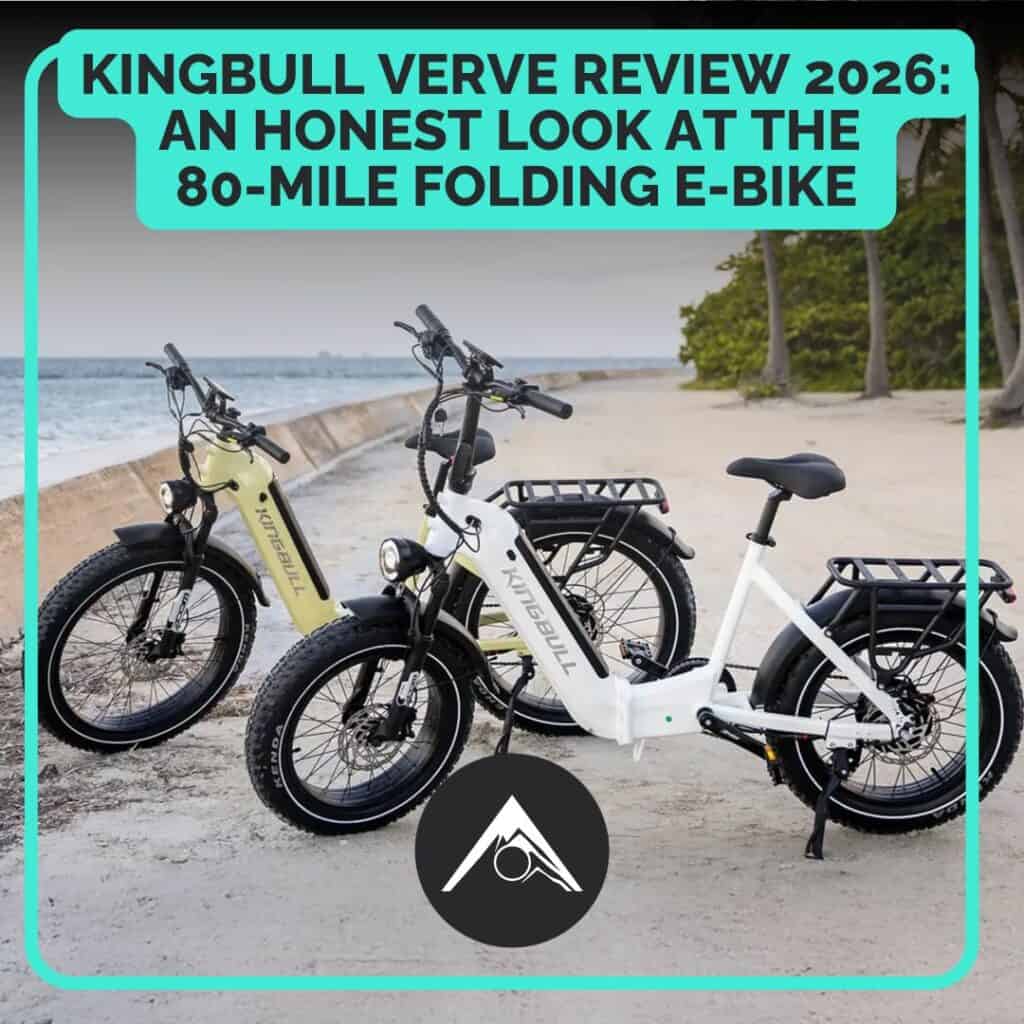
Kingbull Verve Review 2026:
An Honest Look at the 80-Mile Folding E-Bike
The Kingbull Verve isn’t trying to be the lightest folding e-bike on the market. It’s not trying to be the cheapest, the smallest, or the most refined either. What it is trying to be is the folder you take on long rides without thinking about the battery — a 20-inch fat-tire e-bike with a 960Wh Samsung pack, a Bafang 750W motor, and an honest claim of up to 80 miles of range per charge.
For digital nomads, van-lifers, and road-trippers, that’s a tempting pitch. You park the camper, pull the bike out, and ride a 40-mile loop without worrying about whether you’ll make it back. Most folders can’t credibly promise that.
The question this review answers: does the Verve actually deliver on its long-range promise, what’s it really like to live with on the road, and where does it fall short? We’ve pulled together hands-on test data from Electric Bike Report, aggregated reviewer feedback from BikeRide, and owner reports from Trustpilot and Kingbull’s own page — then filtered everything through the lens of someone who actually wants to use a bike like this from a vehicle, on the road, for months at a time.
Short version: the Verve is the right bike for a specific kind of rider, and the wrong one for everyone else. Here’s the full breakdown.
The Quick Verdict
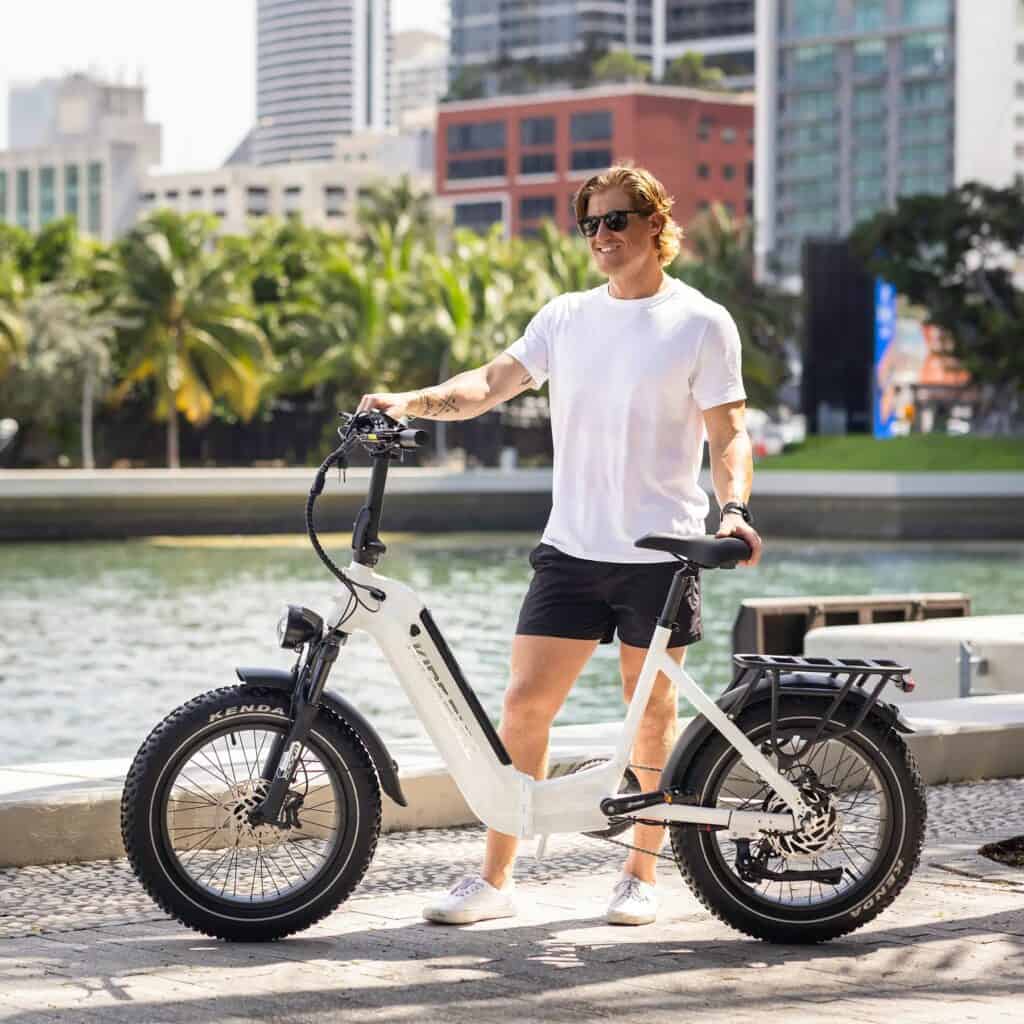
If you’re car-based, US-bound, and you want a folding e-bike that prioritizes range and ruggedness over light weight, the Verve is one of the strongest options under $1,500. The hands-on data backs up the marketing on range and braking. The honest tradeoffs are weight (78.6 lbs tested, not exactly trunk-friendly), a folded size that’s larger than Kingbull advertises, and a long reach that disadvantages riders under about 5’8″.
Kingbull Verve at a Glance
- Price: $1,349 sale (regular $2,099)
- Motor: Bafang G063 750W brushless rear hub, 1,400W peak, 90 N·m torque
- Battery: 48V / 960Wh Samsung INR21700-50G cells, UL 2580 certified
- Range: Up to 80 miles claimed (Electric Bike Report tested 105.8 miles at PAS 1, 46.6 miles at PAS 5)
- Top speed: 20 mph default (Class 2), unlockable to 28 mph (Class 3)
- Weight: 77 lbs claimed, 78.6 lbs as tested by Electric Bike Report
- Folded dimensions: 30.7″ × 17.7″ × 31.5″ claimed (BikeRide measured closer to 36″ × 21″ × 32″ in practice)
- Tires: Kenda K-1188, 20″ × 4.0″ fat, puncture-proof
- Brakes: Tektro HD-E3940 hydraulic, 4-piston, 180mm rotors front and rear
- Drivetrain: Shimano 8-speed (M315/M310)
- Suspension: ZOOM 879 front fork, 80mm travel, lockable
- Sensors: Torque sensor + brake sensor + twist throttle
- Safety: UL 2849 certified (full bike electrical system)
- Water resistance: IPX6
- Max payload: 450 lbs
- Rider height range: 5’2″ – 6’6″ (Kingbull’s claim; independent reviewers suggest 5’10″+ is more realistic)
- Warranty: 2 years
- Shipping: US warehouse in California; free shipping; 2 business day handling
Who the Verve Is For (and Who Should Skip It)
Before going further: this isn’t a bike for everyone. The honest fit assessment matters more than any spec, so here it is upfront.
The Verve is a strong fit if you:
- Are based in the US (Kingbull doesn’t ship internationally)
- Have a car, SUV, van, or RV — ideally with cargo space larger than a sedan trunk
- Are at least 5’8″, and ideally 5’10” or taller
- Want long range more than light weight
- Plan to ride on varied terrain (gravel, beach paths, packed dirt) as well as pavement
- Are comfortable with direct-to-consumer support (no traditional dealer network)
- Your budget is around $1,200–$1,500
Skip the Verve if you:
- Live outside the US
- Are under 5’7″ (the reach is too long for most shorter riders)
- Need to lift the bike onto public transit, into an apartment elevator, or up stairs regularly
- Want a pure city commuter on skinny tires
- Want app integration, GPS tracking, or OTA firmware updates
- Need to fly with the bike (folding doesn’t make it light enough for checked luggage)
What Electric Bike Report Actually Tested
The most important hands-on review of the Verve to date comes from Electric Bike Report, published April 2026. Their tested numbers are the strongest decision-relevant data points available, so it’s worth pulling them out clearly.
Range, PAS 1 (minimum assist): 105.8 miles. That’s not a typo. EBR explicitly notes this is the longest range they’ve ever recorded on a folding e-bike, by a wide margin. The runner-up was the Lectric XP4 long-range version at 840Wh — and the Verve has 960Wh on tap.
Range, PAS 5 (maximum assist): 46.6 miles, with an average held speed of 16.1 mph. EBR notes this is conservative for the category (most folders hit 17–19 mph on this same test protocol), suggesting the torque sensor is tuned to favor efficiency over raw power output.
Brake test: 20 feet 8 inches from 20 mph to stop. EBR calls this nearly two feet better than the current e-bike average — a direct consequence of the 4-piston Tektro calipers, which are essentially unheard of in folders at this price.
Weight as tested: 78.6 lbs vs. Kingbull’s claimed 77 lbs. Not a huge discrepancy, but worth knowing.
The headline takeaway from EBR’s review titled the Verve as “the folder with the most range” they’ve tested, while flagging the weight as one of the heaviest in the category. Both can be true at once — and that tradeoff is essentially the bike’s whole identity.
Motor and Power: The Bafang 750W in Practice
The Verve runs a Bafang G063 brushless rear hub motor rated at 750W nominal with a 1,400W peak and 90 N·m of torque. Bafang motors are a known quantity in this segment — not premium-tier like Bosch or Shimano mid-drives, but reliable, well-supported, and easy to service.
EBR’s hill testing showed the Verve climbing their substitute test hill in about 1:45 on throttle alone (averaging 17.5 mph) and around 2:04 on pedal assist (averaging 14.6 mph). Their conclusion: this bike has no trouble with hills. For a digital nomad rolling into a hilly destination like the Pacific Northwest coast or Vermont, that’s a meaningful capability — many lighter folders bog down on sustained climbs.
The honest catch is in the Class 3 mode. Kingbull markets the bike as adjustable up to 28 mph, but EBR found that even in PAS 5 with the limit unlocked, sustaining 22 mph required real effort, and getting to 24.5 mph wasn’t sustainable for more than a few seconds. Treat the Verve as a confident Class 2 cruiser rather than a true 28 mph Class 3 bike, and you’ll set realistic expectations.
The torque sensor (Kingbull’s “TorqueSense Drive,” using a TROG-1B sensor) reads how hard you’re pedaling and scales motor output accordingly. The result is a more natural pedaling feel than older cadence-sensor systems, but EBR’s reviewer noted the tuning leaves some peak power on the table unless you actively use the throttle.
Battery and Range: The Headline Feature
The Verve’s 48V / 960Wh battery is the single biggest reason to consider this bike. It’s built with Samsung INR21700-50G cells — a known-good cell that’s UL 2580 certified — and the full-bike electrical system carries UL 2849 certification.
That UL 2849 cert matters more than it sounds. E-bike battery fires have become enough of an issue that New York City has banned non-UL-certified e-bikes from many residential buildings. UL 2849 covers the entire electrical system (controller, charger, wiring, battery), not just the cells. Plenty of cheap direct-to-consumer e-bikes skip this certification because it costs money. Kingbull doesn’t, and they publish the certification PDF on the product page.
Real-world range for a typical nomad rider — average weight, mixed terrain, some throttle, some pedal assist around PAS 3 — will land somewhere in the 35 to 60 mile range per charge. That’s the band where the Verve genuinely shines. For someone running short trail rides, beach loops, and the occasional town run from a campsite, this means you might charge twice a week instead of every other day.
The included charger is a 3A US-standard unit, UL-certified. A full charge from empty takes around 7 hours. That’s slower than fast-charging options, but it works fine off any campground hookup, and as we’ll get to below, it also works off a 1,000W inverter in a van or RV.
Brakes, Drivetrain, and Build Quality
The Tektro HD-E3940 4-piston hydraulic brakes are the most over-built component on this bike. Most folders in the sub-$1,500 segment ship with 2-piston brakes — which are adequate, but not great when you’re carrying 200+ pounds of rider plus battery plus cargo at 25 mph downhill. The 4-piston setup with 180mm rotors front and rear is the kind of thing you usually see on full-sized e-bikes priced $500 higher.
EBR’s measured stopping distance (20’8″ from 20 mph) is a direct payoff. Nearly two feet shorter than the e-bike average is a real safety margin.
The Shimano 8-speed drivetrain (SL-M315 shifter, RD-M310 derailleur) is mid-tier — not premium, but a noticeable step above the 7-speed Tourney systems on competitor folders like the Mokwheel Slate. For most riders, it’ll be smooth and reliable. Plan to have it tuned by a local shop after assembly; out-of-box derailleur alignment on direct-to-consumer e-bikes is rarely perfect.
The aluminum frame uses an integrated, removable battery and internal cable routing — both nice touches at this price. The frame geometry is what EBR calls a “wide U-shape,” and they note this introduces some flex in hard cornering. For relaxed cruising it’s not noticeable; for aggressive riding, you’ll feel it.
Front suspension is an 80mm ZOOM coil-spring fork with adjustable damping and a lockout. It’s not a premium air fork, but it’s plenty for the surfaces this bike is built for — bumpy pavement, gravel, packed dirt. Lock it out for road riding to conserve pedaling efficiency.
The Folding Experience: What the Marketing Doesn’t Mention
Kingbull advertises folded dimensions of 30.7″ × 17.7″ × 31.5″ — small enough to imply easy SUV trunk fit. The reality is messier.
BikeRide’s hands-on assessment measured the Verve closer to 36″ × 21″ × 32″ when folded. That’s roughly six inches longer and four inches wider than the marketing claim. The difference matters: it’s the gap between “fits in most sedan trunks” and “barely fits in some sedan trunks.” If you’re planning vehicle transport, pre-measure your cargo space against the larger real-world dimensions, not the optimistic spec sheet.
The fold mechanism itself works well. The frame collapses at a central hinge, the handlebar stem folds down, and the pedals fold flat — EBR praises the latches as solid when riding and quick to release when folding. The whole process takes about 30 seconds once you’ve done it a few times.
The harder part is lifting it after you’ve folded it. At 78.6 lbs (and 8 lbs of that is in the removable battery), this is a bike where battery removal isn’t optional — it’s the practical workflow. Pop the battery out first, then lift the ~70 lb frame. Solo loading into an SUV cargo floor is doable for most adults, but it’s real work. Two people, trivial. One person with a bad back, probably not a good plan.
The Verve for Digital Nomads: Real-World Use Cases
Specs are one thing. How the bike actually integrates into a road-based nomad life is another. Here’s what to plan for.
Vehicle fit
Using the real-world folded size of around 36″ × 21″ × 32″:
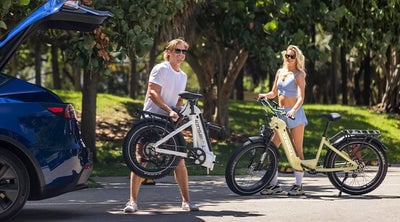
- Compact sedan trunk: Tight to impossible. The 32″ folded height in particular will rub many trunk lids. If a sedan is your only vehicle, consider the lighter Lectric XP4 instead.
- Midsize sedan or hatchback: Doable but tight. Pre-measure. Remove the battery before lifting.
- SUV or crossover: Easy fit in most cargo areas. This is the Verve’s natural home.
- Minivan, Sprinter van, Class B campervan, Class C RV: Trivial fit. Plenty of room to spare.
- Hitch-mounted bike rack: Make sure your rack is rated for at least 80 lbs per bike. Many basic trunk-strap racks aren’t.
Charging on the road
The 3A / 168W charger is undemanding by RV standards. Any 1,000W pure-sine-wave inverter will handle it without breaking a sweat. Many factory-equipped Class B and Class C RVs come with inverters in this range, which means you can charge the Verve off your house battery bank without needing shore power — particularly useful if you boondock.
A 200W rooftop solar panel can offset the daytime parasitic load while the bike charges from your battery bank, though a full 960Wh refill will pull meaningfully from the house batteries. Plan accordingly if you’re trying to stay off-grid for extended stretches.
Beach paths, gravel, and mixed terrain
This is where the 20″ × 4.0″ Kenda fat tires earn their keep. Most folding e-bikes ship with skinny commuter tires (2.4–3″ wide) that are fine on pavement and miserable on packed sand or loose gravel. The Verve’s wider profile lets you ride confidently on beach access trails, fire roads, and the kind of mixed surfaces nomads actually encounter at scenic destinations.
For deep sand or soft surfaces, drop tire pressure to 5–10 PSI. For pavement, pump back up to 15–20 PSI (running fat tires too soft on hard surfaces accelerates wear). The puncture-resistant tire construction is a nice safeguard for anyone riding on goat-head territory in the American Southwest.
Using it as a car-replacement
The 450 lb payload capacity and 150 lb rear rack capacity make the Verve one of the more cargo-capable folders. Owner reviews on Kingbull’s own page describe households of three sharing a single car, with the Verve handling errands and short trips. Add a basket or pannier setup and you’ve got real grocery-run capability.
Kingbull Verve vs. The Competition
The folding fat-tire e-bike segment under $1,500 is more crowded than it was even two years ago. Here’s how the Verve stacks up against the most direct competitors. (For a fuller brand-level comparison, see our Kingbull Bikes brand review.)
vs. Lectric XP4 ($1,299 long-range version): The XP4 is lighter (~70 lbs), cheaper, more refined, and has a smoother folding experience. It also has US-based phone support and a strong reputation. But it has a smaller 840Wh battery, weaker 2-piston brakes, lower 330 lb payload capacity, and only a 1-year warranty. If portability matters more than range, the XP4 wins. If range and payload matter more, the Verve wins.
vs. Heybike Mars 3.0 (~$1,199): The Mars has full suspension, app integration, integrated turn signals, and NFC unlock — features the Verve lacks entirely. But the Mars only has a 624Wh battery (US spec), 100 lb rear rack capacity, IPX5 vs. the Verve’s IPX6, and a 1-year warranty. The Mars is more tech-forward and feature-rich; the Verve is more rugged and longer-ranging.
vs. Engwe Engine Pro 2.0 (~$1,099–$1,399): The Engine Pro has full suspension at a comparable price, but it weighs around 88 lbs (heaviest in this comparison), has weaker 160mm brake rotors, no UL certification, only a 1-year warranty, and Engwe has had an active battery recall on some units with reports of the company asking customers not to publicize the recall. Service requires shipping back to overseas warehouses. The Verve wins on safety credentials by a substantial margin.
vs. Mokwheel Slate (~$1,499): The Slate is the lightest in the comparison at 64 lbs, with a slick design, anti-theft detachable display, and turn signals. But it has a much weaker 500W motor (860W peak vs. the Verve’s 1,400W peak), narrower 3″ tires, smaller 720Wh battery, weaker Tourney 7-speed drivetrain, and an awkward folding mechanism that’s been widely criticized. If you want a light city folder, the Slate is interesting. If you want a capable all-terrain folder, the Verve is the stronger pick.
The Honest Negatives
Every review section needs cons, and these aren’t bullet-pointed throwaways. These are the things that should genuinely affect your buying decision.
1. The weight is significant. 78.6 lbs as tested. Battery removal before lifting isn’t optional, it’s the workflow. If you’re a smaller-framed rider, an older rider, or anyone with back issues, this matters. Some of the convenience of a folding bike (toss it in the trunk and go) is genuinely compromised by the weight.
2. Folded size larger than advertised. Kingbull’s claimed 30.7″ × 17.7″ × 31.5″ is optimistic. BikeRide measured around 36″ × 21″ × 32″ in practice. The difference can be the difference between fitting your trunk and not. Measure before you buy.
3. The reach favors taller riders. EBR’s reviewer (no height specified) noted his arms were nearly fully extended. BikeRide’s panel of YouTube testers found a 5’11” reviewer concluded the bike was unsuitable for anyone under 5’10”. Kingbull claims it fits riders from 5’2″ — which is technically true (the seat goes that low) but practically misleading. If you’re under 5’8″, plan on either swapping the stem for a shorter one or looking at a different bike.
4. Class 3 mode underperforms its marketing. The bike is sold as adjustable to 28 mph. In practice, EBR found that sustaining anything over 22 mph required hard effort, and 24.5 mph wasn’t sustainable for more than a few seconds. This is a strong Class 2 cruiser, not a true Class 3 commuter.
5. The on-site reviews are heavily curated. All 57 reviews on Kingbull’s product page are 5-star, which is statistically implausible. Trustpilot has flagged Kingbull’s broader profile with the note that they’ve removed fake reviews from the company’s account. Treat the on-site reviews as marketing and look at third-party sources for balance.
6. The independent review pool is thin. Outside of Electric Bike Report’s hands-on review, BikeRide’s aggregator scoring, and Electric Bike Explorer’s desk review, there isn’t much. None of the larger outdoor publications (Outdoor Life, Popular Science, The Inertia, OutdoorGearLab, Wired) have tested this bike. Reddit signal is essentially zero. That doesn’t make it a bad bike — it makes it an under-covered one. Buy accordingly.
7. No app or smart features. Unlike the Heybike Mars 3.0 or the Mokwheel Slate, the Verve has no app integration, no Bluetooth tuning, no GPS tracking, no OTA firmware updates. What you see is what you get. For some buyers this is a feature (less to go wrong); for others, it’s a real omission.
8. Replacement batteries aren’t yet stocked. Owner reviews from mid-2025 mention waiting for spare batteries to become available for purchase. For a road-trip nomad who’d value redundancy, this is a real consideration — though it’s likely to be resolved as the bike’s been on sale longer.
Return Policy, Warranty, and Support
One area where Kingbull’s policies need to be read carefully before you commit:
Warranty: 2 years. Industry standard is 1 year, so this is genuinely a positive. As with all warranties, wear items (tires, chain, brake pads) are excluded, which is standard practice.
Return policy: 15 days, but with significant caveats. There’s a $150 return fee per bike ($230 from Hawaii), plus a 10% handling fee. You can only return a bike with fewer than 10 miles on the odometer. Original packaging is required. Photos and videos are required before the return is approved. Quality-issue returns get full refunds including shipping, but a “I changed my mind” return will cost you a meaningful chunk of the bike’s price.
Translation: be reasonably sure before you order. This isn’t a try-it-and-see-if-you-like-it kind of purchase.
Support: Kingbull is a direct-to-consumer brand, so support is email and phone, not a local dealer. Trustpilot reviews of their service are mixed-positive — multiple owners specifically mention a rep named Elsa for quick responses, including on weekends. There’s also at least one documented case of a customer reporting a bike that arrived with broken brakes and leaking shocks, with Kingbull refusing the return. One data point, not a pattern, but worth knowing exists.
Should You Buy the Kingbull Verve?
Yes, if:
- You’re US-based and have a vehicle larger than a compact sedan
- You’re 5’8″ or taller (5’10″+ ideally)
- Long range matters to you more than light weight
- You’ll ride on varied terrain — pavement, gravel, beach paths, light trails
- You value UL 2849 safety certification and a 2-year warranty
- You’re comfortable doing basic maintenance yourself or finding an independent local mechanic
- Your budget is $1,300–$1,500
No, if:
- You’re outside the US
- You’re under 5’7″
- You need a bike you can lift onto public transit or up apartment stairs
- You want a smart bike with app integration
- You only ride on pavement and want the lightest possible folder
- You need to fly with the bike
For the right kind of rider — and specifically for the road-trip, van-life, and US-touring digital nomad — the Verve hits an unusual combination of long range, real off-road capability, strong braking, and safety credentials at a price that undercuts most full-sized e-bikes with similar specs.
Kingbull Verve Review: Frequently Asked Questions
Is the Kingbull Verve worth the price?
For the $1,349 sale price, the Verve offers a 960Wh battery (largest in the folding category), 4-piston hydraulic brakes (rare at this price), UL 2849 certification, and a 2-year warranty. The spec sheet competes well with bikes priced $500 higher. The honest caveat is that the bike’s heavy weight and long reach mean it’s not a fit for every rider — but for the right rider, the value is real.
How long does the battery actually last on a single charge?
Electric Bike Report’s hands-on testing showed 105.8 miles at PAS 1 (minimum assist) and 46.6 miles at PAS 5 (maximum assist). Realistic mixed-use range for a typical rider is in the 35–60 mile band per charge, depending on terrain, rider weight, wind, and how much throttle versus pedal assist you use. That’s enough range for most nomads to ride multiple days from a single campground without recharging.
Will the Kingbull Verve fit in my car?
The real-world folded size is closer to 36″ × 21″ × 32″ than Kingbull’s claimed 30.7″ × 17.7″ × 31.5″. It fits easily in most SUVs, minivans, vans, and RVs. It fits tightly or marginally in midsize sedan trunks and hatchbacks. Pre-measure your specific vehicle’s cargo space before ordering. For sedan owners, a lighter folder like the Lectric XP4 (37″ × 17″ × 29″) is a better fit.
Can I really lift this bike alone?
Yes, but with a workflow. The bike weighs 78.6 lbs as tested. The 8-lb battery is removable. Take the battery out first, then lift the ~70 lb frame. For most average-strength adults, this is manageable for an SUV cargo floor. Two-person lifting is much easier. If you have back issues or limited strength, this isn’t the right bike for you.
Is the Kingbull Verve safe? What about battery fires?
The Verve carries UL 2849 certification for the full electrical system and uses Samsung INR21700-50G cells with UL 2580 certification. UL 2849 is the standard that addresses e-bike battery fire concerns — it’s why New York City has restricted non-UL-certified e-bikes from many buildings. Kingbull publishes the certification document on the product page. This is genuinely a safety advantage over uncertified competitors at the same price point.
How long does shipping take, and where does it ship from?
Kingbull ships from a California warehouse within 2 business days of order. Total delivery is typically 2–5 business days within the continental US. Free shipping is included. The bike arrives roughly 85% pre-assembled — basic final assembly is required, which most owners report taking 30–60 minutes. For a polished setup, plan to take the bike to a local shop for a brake bleed and derailleur tune after assembly.
Does the Kingbull Verve ship internationally?
No. Kingbull’s warehouse and shipping infrastructure are US-only. International nomads will need to look at local brands in their region (Tenways or Legend in Europe, for example) or use local bike-sharing services instead.
What’s the difference between the Verve and the Lectric XP4?
Short version: the Lectric XP4 is lighter, cheaper, more refined, and has stronger US-based support. The Verve has a larger battery, stronger 4-piston brakes, higher payload capacity (450 vs. 330 lbs), wider fat tires, and a longer 2-year warranty (vs. Lectric’s 1-year). For pure portability and ease of ownership, the XP4 wins. For range, ruggedness, and off-pavement capability, the Verve wins.
The Bottom Line
The Kingbull Verve is one of the most range-capable folding e-bikes you can buy for under $1,500, and it’s genuinely backed by hands-on testing data rather than just marketing claims. The 4-piston brakes, UL 2849 certification, 2-year warranty, and 450 lb payload capacity put it on a different tier than most direct-to-consumer competitors at this price.
It’s not the right bike for everyone — it’s too heavy for some, too long-reach for shorter riders, and too bulky for compact sedan trunks. But for the US-based road-tripper, van-lifer, or slow-traveling digital nomad with an SUV or larger vehicle, who wants a single folding e-bike that handles beach paths in the morning and town runs in the afternoon without ever worrying about range, the Verve is the strongest single recommendation in its segment.
If that description fits you, this is the folder to buy.
The world is our office. The Verve is a pretty good way to get there.